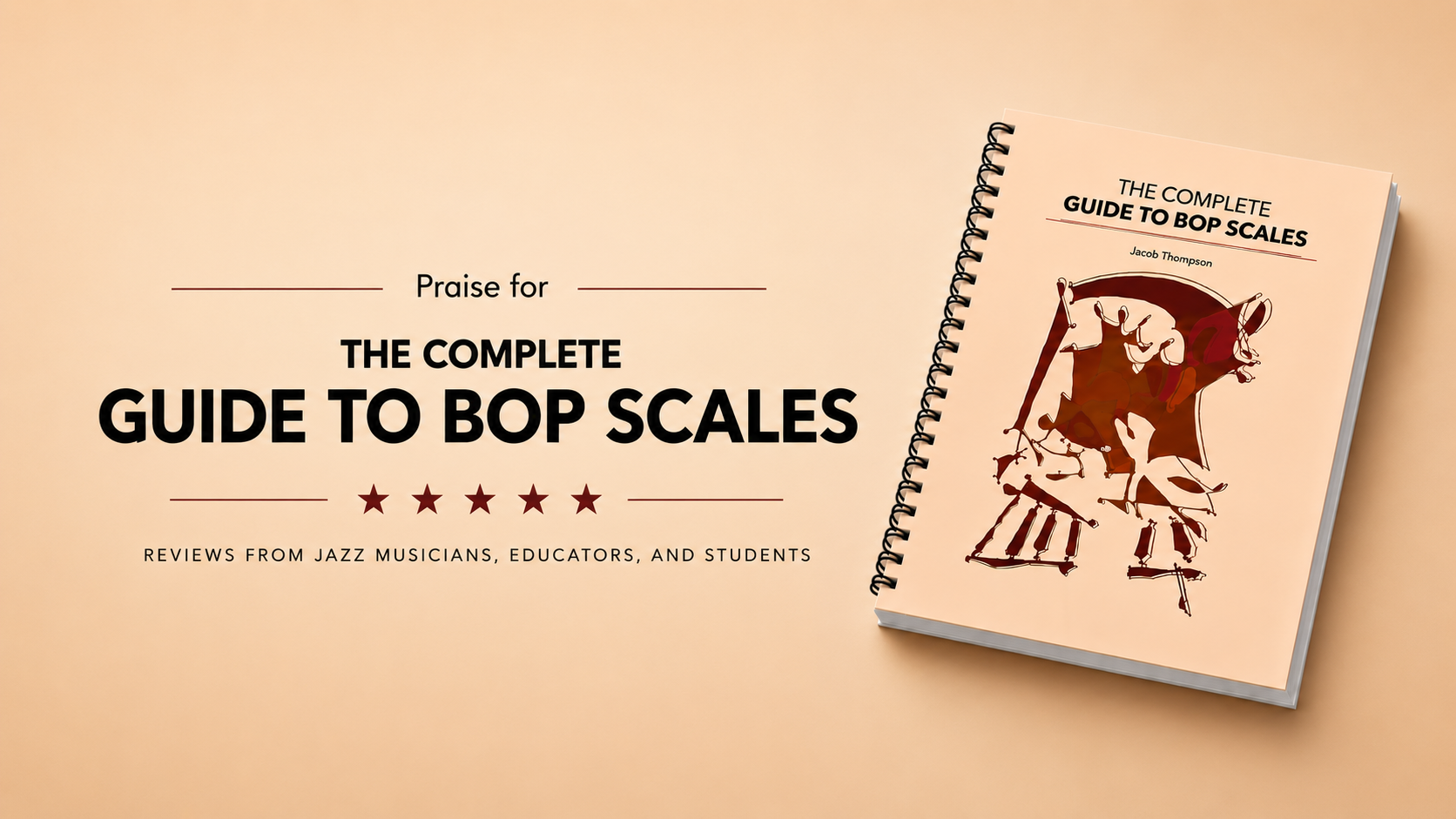
For the intermediate to advanced student of jazz improvisation, Jacob’s guide is a valuable aid.
Anyone with a keen interest in the WHY, who is willing to put in the thought, patience and practice it takes to be a good improviser, this book will give them the tools to improve quickly.
It’s a great look at the details - the nitty gritty of our Great American Music.
Clear and well-conceived. A wonderful resource for creating lines.
Jacob Thompson has done an extraordinarily thorough job of categorizing the chromaticism that is at the heart of bebop as the root of all modern jazz vocabulary. Drawing inspiration from the work of Barry Harris and Mark Levine among others, it’s well conceived and laid out, replete with many references to recorded examples.
Many people have asked me about publishing method books, but few have followed through, let alone to this degree. The Complete Guide To Bop Scales is a valuable addition to jazz pedagogy!
I have never come across a more complete discussion of the scales used in Bop and the application of these scales to making music.
The organization and musical progression, with examples and exercises would be of great assistance to anyone who wants to learn the language of bop, or improve their own playing.
I particularly like the chapter on Bop scale melodies. The goal of great improvisation should be in creating memorable melodies.
The analysis of lines using different techniques, enclosures, segments is exhaustive.
I like having examples from actual recordings of Jazz artists. There is a wealth of examples from the masters in this volume. Highly recommended.
For the first time, I actually understand bebop scales—something I never could grasp before reading this!
The author breaks everything down in a systematic way that makes the concepts stick. I’ve been wanting to think and play outside the box for a while, and I am already using these scales in my daily playing to do just that.
As a non-native English speaker, I also appreciated how clear, accessible, and easy to read the language is. I recommend this book hands down!
Jacob Thompson has created an incredibly clear and concise guide for understanding and implementing bop scales into jazz language.
As an educator who specializes in teaching advanced high school students, I’ve always found that there is a lack of clarity in pre-existing popular material. This results in a long process and having to research the subject thoroughly.
The Complete Guide to Bop Scales takes Jacob’s very thorough research and presents a method that is easy to follow with an emphasis on getting to the music sooner than later. I look forward to using it in my future teachings.
The Complete Guide To Bop Scales is an excellent repository for the intermediate and advanced jazz student. It is the most comprehensive overview of bop scales available.
This book contains both practical exercises for immediate application as well as advanced theoretical concepts that will challenge even the most seasoned bopper.
Thompson’s focus on musical examples and jazz history grounds the book in the tradition and provides authentic musical language.
Jacob Thompson brings to this book the same profound thoughtfulness and sensitivity I’ve had the pleasure of witnessing up close.
The Complete Guide to Bop Scales is a window into how Jacob approaches a technical question — with great focus and creativity — offering both insights on structures in music we love, and accessible tools that every musician can harness in their own creating.